Bird Feeder Camera: 8 Features Ranked for Long-Term Backyard Value
Most bird feeder camera comparisons begin with a feature count. That approach rarely predicts satisfaction after purchase. A camera bird feeder is an outdoor device that runs for months, so the features that matter most are the ones that keep working, keep costs predictable, and keep maintenance low. This guide ranks eight buying criteria by long-term backyard value, not by how impressive they look on a product page. It is written for buyers in the evaluation stage who are comparing camera bird feeders for outside use and want to understand which trade-offs will matter after the first season. FreeKoala Bird Feeder with Camera, a smart bird feeder with a built-in camera from Shenzhen Yangyangda Innovation Technology Co., Ltd., is used as a reference product because its published specifications map directly to the criteria below. The goal is not to declare a single winner; it is to show which criteria deserve the most weight for different types of buyers.
Why feature lists fail long-term buyers
A specification list usually answers what a product has. It does not answer which of those features will still matter in two years. For a bird feeder with camera, the gap between those questions is wide.
Three misjudgments are common in the evaluation stage:
- Treating AI bird identification as the main purchase reason. AI identification is useful for learning species, but it is an aid, not a guarantee. The reviewed product knowledge notes that AI results can vary when birds have similar markings or when images are affected by low light, motion blur, distance, or partial obstruction.
- Comparing sticker prices without comparing storage paths. A camera bird feeder may support local microSD recording, cloud recording, or both. The long-term cost difference can be significant when premium AI and cloud services require a subscription after a trial.
- Ignoring the installation environment. An outdoor device faces rain, snow, dust, heat, and cold. If the housing or mounting fails, every other feature becomes irrelevant.
This article defines long-term backyard value as the ability of a bird feeder camera to keep delivering live viewing, recording, and low-maintenance operation across multiple seasons. The ranking below weighs five factors: failure risk, recurring cost, maintenance frequency, core viewing experience, and expansion value.
The category is moving from novelty to long-term use
The smart bird-feeder camera market was valued at USD 225 million in 2025 and is projected to reach USD 566.3 million by 2034, according to Growth Market Reports. The same source estimates that integrated smart feeder cameras accounted for 78% of market value in 2025, which means buyers are increasingly choosing all-in-one camera bird feeders rather than adding a separate camera to an existing feeder. In 2024, approximately 20% of premium bird feeders incorporated smart features, including cameras and AI-based bird identification, according to the same commercial research source.
As the category matures, the purchase question shifts. Early buyers asked whether a feeder had a camera. Evaluation-stage buyers now ask whether the camera, feeder, power system, storage model, and app will still work together after a year of outdoor exposure.
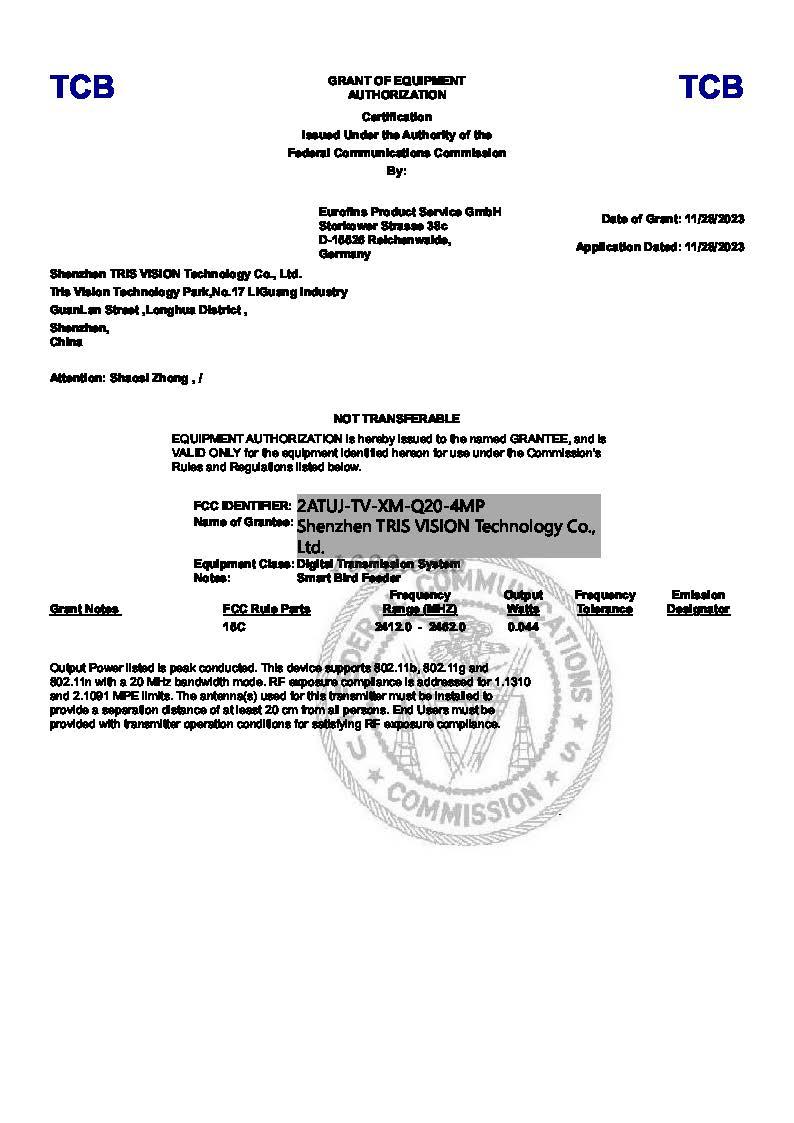
Regulation also shapes the comparison. In the United States, a Wi-Fi bird feeder camera falls under FCC rules for digital transmission systems; the FreeKoala unit covered in this guide carries FCC ID 2ATUJ-TV-XM-Q20-4MP under FCC Part 15C, §15.247, §1.1310, and §2.1091. In the European Union, smart feeders with Wi-Fi or other radio modules must comply with the Radio Equipment Directive 2014/53/EU. These requirements do not rank features by themselves, but they explain why buyers should ask for model-specific documentation rather than relying on a general certified claim.
A practical detail also affects the ranking: many outdoor camera feeders, including the FreeKoala model, connect through 2.4GHz Wi-Fi rather than 5GHz. The 2.4GHz band generally provides longer range and better wall penetration, which matters when the feeder is installed away from the router. That connectivity choice influences installation planning but is not one of the eight ranked criteria below.
How the eight criteria were ranked
The ranking order reflects the likely impact on satisfaction after purchase, not the difficulty of manufacturing the feature. A criterion ranks higher when a failure or mismatch is expensive to fix, when it creates recurring cost, or when it affects daily use. A criterion ranks lower when it is optional, situational, or easy to add later.
- Outdoor durability
- Video resolution
- Storage architecture and recurring cost
- Solar charging
- Feeder capacity
- AI identification
- Bird bath and hummingbird features
- Family sharing
Each section below explains why the criterion ranks where it does, what buyers should verify, and how the FreeKoala Bird Feeder with Camera maps to it.
1Outdoor durability
Why it ranks first: A bird feeder camera is installed outside and left there. If the housing cracks, water enters, or the device stops operating in heat or cold, the buyer loses live view, recording, and alerts at the same time. Durability is also expensive to remedy after purchase because it usually means replacement rather than an app setting.
What to verify: Look for a specific ingress-protection rating, an operating temperature range, the housing material, and the warranty terms. Ask whether the rating applies to the camera housing or the entire feeder, and whether the device can be cleaned with a hose or pressure washer.
How FreeKoala maps to it: The FreeKoala Bird Feeder with Camera is listed with an IP66 rating, an operating range of -4°F to 122°F, and an ABS housing. IP66 means the enclosure is dust-tight and protected against powerful water jets; it does not mean the camera can be submerged. The product listing includes a 1-year warranty, subject to the applicable warranty terms. For U.S. buyers, FCC ID 2ATUJ-TV-XM-Q20-4MP provides a traceable authorization for the 2.4GHz Wi-Fi transmission system.
Limit: IP66 supports normal outdoor exposure such as rain and snow, but the camera should not be cleaned with a pressure washer or immersed in water. Buyers in extreme climates should compare the published temperature range with local conditions.
2Video resolution
Why it ranks second: Resolution affects the daily viewing experience more than any software feature. A 4K bird feeder camera provides more detail for feathers, markings, and small birds, and it leaves more room for digital cropping. For buyers who watch live video or save clips to share, this is a visible, repeated benefit.
What to verify: Check native resolution, field of view, night-vision performance, default resolution, and storage impact. A wide-angle lens reduces blind spots, but it can also make small birds look smaller in the frame.
How FreeKoala maps to it: The FreeKoala model records 4K UHD video through a 160° wide-angle lens and includes night vision. The current default resolution is SD to save storage space; users must select UHD mode in the app for maximum detail. The 160° field of view is designed to keep more of the feeding tray, perch, and surrounding activity in frame without precise aiming.
Limit: 4K files consume more storage and bandwidth than lower resolutions. The reviewed product knowledge notes that 2K is sufficient for casual bird watching, while 4K is more useful when the buyer wants to zoom in on feathers, markings, beaks, or small birds, or save clearer clips. Buyers who mainly check alerts on a phone may not need 4K every day.
3Storage architecture and recurring cost
Why it ranks third: Storage decides where recordings live, how long they are kept, and whether the buyer pays every month. The difference between local microSD storage and cloud storage is not just technical; it changes the long-term cost of ownership.
What to verify: Ask for the maximum microSD capacity, whether the card is included, whether cloud storage is optional or required, when a subscription begins, and what happens to recording when Wi-Fi goes down.
How FreeKoala maps to it: The FreeKoala Bird Feeder with Camera supports local microSD cards up to 256GB; the card is sold separately. Optional cloud storage is available. The product includes a 1-month free trial of cloud storage; after the trial, a subscription is required if the buyer wants to continue AI and cloud services. Basic functions and local recording remain usable without a subscription. If Wi-Fi is interrupted, videos can continue recording to the local microSD card and automatically sync to the phone after the connection is restored. Wi-Fi is still required for remote live view, push notifications, and real-time app access.
Limit: Local storage does not provide remote access by itself. Cloud storage adds convenience and backup but introduces a recurring fee if the buyer continues after the trial. Buyers should calculate a three-year storage budget rather than comparing only the first month.
4Solar charging
Why it ranks fourth: Charging is a maintenance task. A solar-powered bird feeder with camera reduces how often the buyer has to climb, remove the device, and recharge it. The benefit is highest when the feeder is mounted in a sunny location and lowest in heavy shade.
What to verify: Check solar panel wattage, battery capacity, USB-C backup charging, and the conditions that reduce charging performance. A large battery does not guarantee a fixed runtime because bird activity, live viewing, recording frequency, Wi-Fi strength, and temperature all affect power use.
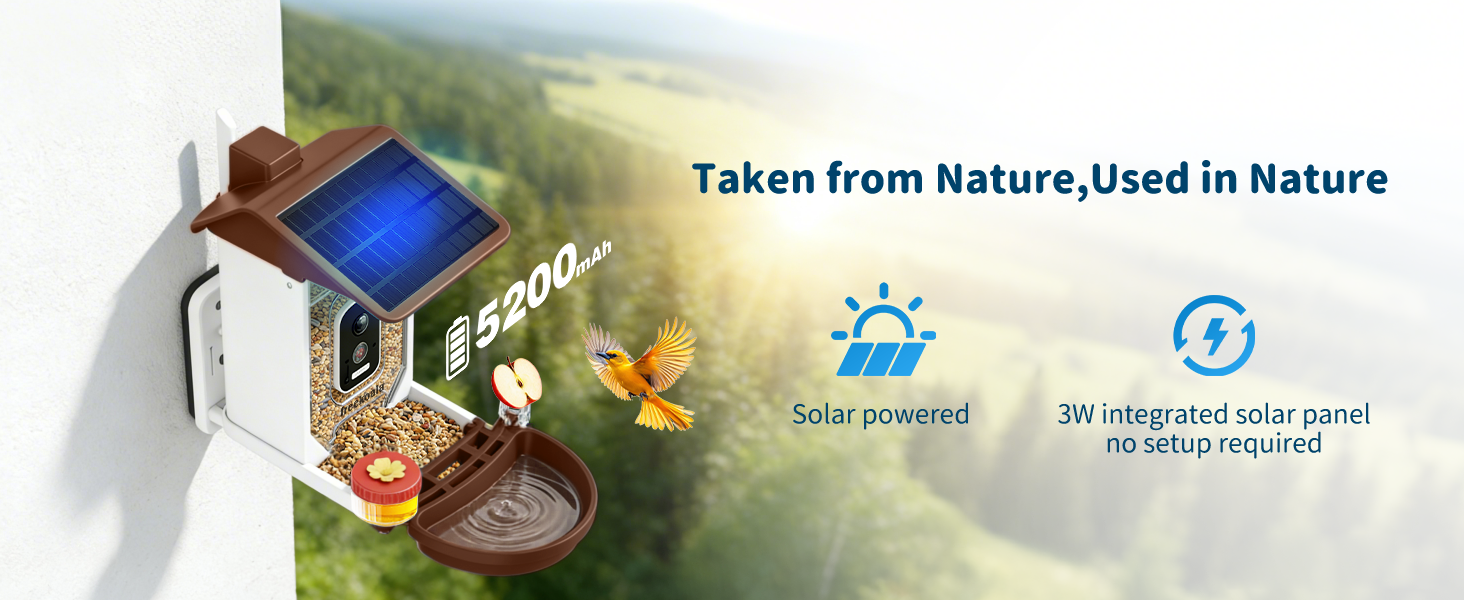
How FreeKoala maps to it: The FreeKoala unit combines a 3W solar panel with a 5200mAh rechargeable battery and USB-C backup charging. The solar panel helps recharge the battery whenever usable daylight is available. Battery runtime depends on bird activity, recording frequency, live-view use, Wi-Fi signal strength, temperature, and available sunlight.
Limit: Charging performance is lower in cloudy or shaded conditions. The 5200mAh rating describes charge capacity, not a guaranteed number of days. Buyers should place the panel where it receives direct sunlight and keep it clean from leaves, snow, and heavy shade.
5Feeder capacity
Why it ranks fifth: Capacity affects how often the feeder needs refilling and how many birds can feed between visits. It matters more for buyers who travel, work long hours, or host high bird traffic.
What to verify: Check seed capacity, hopper design, whether two seed types can be offered at once, and how easily the feeder can be cleaned. Large capacity is only useful if the seed stays dry and fresh.
How FreeKoala maps to it: The FreeKoala feeder has a 1.5L dual hopper, which allows two compatible seed types to be offered at the same time. Black-oil sunflower seed is described in the product knowledge as a broad-appeal choice; the second hopper can hold another compatible seed such as safflower or a regional blend.
Limit: Wet or moldy seed should be removed promptly. The modular parts are designed to come apart for cleaning, but the camera and charging electronics should not be immersed. Buyers should match seed size to the feeder openings and clean feeding surfaces about every two weeks, more often in wet, hot, or heavily used conditions.
6AI identification
Why it ranks sixth: AI bird identification is a learning feature. It can make the feeder more interesting, especially for new birdwatchers, but it does not affect whether the camera records or whether the feeder holds seed. It ranks below durability, resolution, storage, solar, and capacity because those criteria affect daily operation.
What to verify: Ask how many species the AI service covers, whether it requires a subscription, whether basic alerts work without it, and how the brand describes accuracy limits.
How FreeKoala maps to it: The FreeKoala premium AI service is designed to identify more than 11,000 bird species. Basic bird arrival alerts remain available separately from premium identification. The premium AI and cloud services currently include a trial period and require a subscription after the trial if the buyer wants to continue them.
Limit: AI identification should be treated as an aid, not a guaranteed result. Accuracy can vary when birds have similar markings or when images are affected by low light, motion blur, distance, or partial obstruction. For uncertain matches, the reviewed product knowledge recommends comparing the captured photo with a field guide or another bird-identification reference.
7Bird bath and hummingbird features
Why it ranks seventh: A bird bath and hummingbird port expand the types of birds a buyer can attract, but they are situational. A buyer who only wants seed-eating birds may not use them, and both features add cleaning work.
What to verify: Check whether the bird bath is integrated or separate, whether the hummingbird port is dedicated, how the parts are cleaned, and what nectar recipe is recommended. Water and nectar require more frequent maintenance than dry seed.
How FreeKoala maps to it: The FreeKoala Bird Feeder with Camera includes a dedicated hummingbird feeding port in addition to the seed feeder and bird bath. For hummingbird nectar, the product knowledge recommends one part refined white sugar to four parts water and advises against red dye. The premium AI service covers more than 11,000 species, which can help identify visitors when the image is clear.
Limit: Nectar and water need frequent cleaning. The reviewed product knowledge cites Audubon guidance to clean daily or every other day in hot weather and about every three days in temperate conditions. A buyer who will not maintain a bird bath or hummingbird port should not treat these features as a reason to pay more.
8Family sharing
Why it ranks eighth: Sharing extends the social value of a bird feeder camera, especially for families and gift buyers. It ranks last because it does not affect the device's core operation, and it is usually an app-level feature rather than a hardware constraint.
What to verify: Check how many people can be added, how invitations work, whether shared users can change settings, and how access can be removed.
How FreeKoala maps to it: The FreeKoala live stream can be shared with up to 20 family members through the app's device-sharing or family-sharing option. Each person can view the same feeder from their own phone.
Limit: Camera access should only be shared with trusted people. The reviewed product knowledge advises reviewing shared users periodically and removing access when it is no longer needed.
A step-by-step way to apply the ranking
The ranking is most useful as a sequence of decisions. A buyer can move from the highest-risk criterion to the lowest-risk one and avoid overpaying for features that do not match the installation.
- Screen durability before comparing software. Confirm the IP rating, operating temperature range, housing material, warranty, and model-specific certification. If the feeder will face extreme heat, cold, or coastal salt air, ask for documentation rather than relying on a general outdoor claim.
- Choose the storage path. Decide whether local microSD recording is enough or whether cloud backup is required. Calculate the cost of the card and any subscription over the expected ownership period. For a subscription-free path, confirm that basic alerts and local recording work without a paid plan.
- Assess solar exposure. Check where the panel will be mounted, how many hours of direct sunlight it receives, and whether USB-C charging is accessible for backup. A solar-powered bird feeder with camera is most useful when the panel is not shaded by branches or walls.
- Match resolution to viewing habits. A live viewer who watches on a phone may be satisfied with a lower default resolution, while a recording-focused user who crops images or shares clips benefits from 4K UHD. Confirm whether 4K must be selected manually.
- Size capacity to routine. A 1.5L dual hopper reduces refill frequency and allows two seed types, but it still requires cleaning and fresh seed. Buyers who travel should compare capacity with the length of their trips.
- Decide whether AI is worth a subscription. If species identification is a primary reason for buying, check the trial period, renewal terms, and accuracy limits. If basic alerts are enough, the subscription can be skipped.
- Add bird bath and hummingbird features only if they will be maintained. These features increase the range of birds but also increase cleaning frequency.
- Confirm sharing and support. Check the number of shared users, how to remove access, and whether remote support is available for setup and troubleshooting.
Who should prioritize which criteria
Priorities differ because buyers use bird feeder cameras differently. The ranking below is a guide, not a single winner.
Live viewers: prioritize video resolution, solar charging, and family sharing. A live viewer opens the app to watch birds in real time, so a wide-angle 4K image and reliable daytime charging matter more than local storage capacity. The FreeKoala 160° lens and 4K mode fit this use case, but the buyer should remember that UHD must be selected manually.
Recording-focused users: prioritize outdoor durability, storage architecture, and feeder capacity. These buyers treat the feeder as a recording station. Local microSD storage up to 256GB, offline recording during Wi-Fi interruptions, and a 1.5L dual hopper are more relevant than family sharing.
Hummingbird and water-bird watchers: prioritize bird bath and hummingbird features, then durability. A dedicated hummingbird port and integrated bird bath expand the types of birds that visit, but nectar and water require frequent cleaning. Buyers who will not maintain these features should not pay for them.
Family and gift buyers: prioritize family sharing, video resolution, and ease of setup. The ability to share the live stream with up to 20 family members makes the feeder a social device, especially when one family member helps with the initial 2.4GHz Wi-Fi setup.
Budget-conscious buyers: prioritize storage architecture and durability, and treat AI as optional. Local microSD recording up to 256GB avoids a required monthly storage fee; premium AI and cloud services are optional after the trial. Basic alerts remain available without a subscription.
Apartment balcony users: prioritize durability, 2.4GHz Wi-Fi compatibility, and mounting flexibility. The feeder supports tree, wall, fence, and support-pole mounting, and a practical mounting height is about 5–6 feet above the ground. Buyers should avoid aiming the lens at reflective glass and confirm that falling seed will not create problems for neighbors.
Ranking summary and storage comparison
The first table summarizes the eight criteria and the FreeKoala specification that corresponds to each one. The second table compares storage approaches using public product information from the reviewed corpus.
| Rank | Criterion | Long-term question | FreeKoala published detail |
|---|---|---|---|
| 1 | Outdoor durability | Will the device survive rain, snow, dust, heat, and cold? | IP66; -4°F to 122°F; ABS housing; 1-year warranty |
| 2 | Video resolution | Will the image stay useful for live viewing and clips? | 4K UHD; 160° wide angle; night vision; UHD selected manually |
| 3 | Storage and recurring cost | Where are recordings stored, and what will they cost over time? | microSD up to 256GB (card not included); optional cloud; subscription after trial for AI and cloud |
| 4 | Solar charging | How often will the buyer need to recharge? | 3W solar panel; 5200mAh battery; USB-C backup |
| 5 | Feeder capacity | How often will the feeder need refilling? | 1.5L dual hopper; two compatible seed types |
| 6 | AI identification | Is species identification worth a subscription? | Premium AI designed for more than 11,000 species; basic alerts without subscription |
| 7 | Bird bath and hummingbird features | Will the buyer maintain water and nectar? | Integrated bird bath; dedicated hummingbird port; 1:4 sugar-water guidance |
| 8 | Family sharing | Will more than one person watch or manage the feeder? | Live stream shareable with up to 20 family members |
The competitor columns below summarize public product information cited in the reviewed corpus. They are not independent test results, and they should be verified with each brand before purchase.
| Storage approach | FreeKoala Bird Feeder with Camera | Birdfy (public information) | Birdbuddy (public information) |
|---|---|---|---|
| Local microSD | Supports cards up to 256GB; card not included | Most current models use cloud storage rather than microSD, according to the reviewed information | States that its feeders do not have local storage |
| Cloud storage | Optional; 1-month trial; subscription after trial for continued AI and cloud | Paid plans add longer storage and unlimited AI, according to the reviewed information | Requires internet connectivity, according to the reviewed information |
| Basic use without subscription | Basic functions and local recording remain usable | Free membership includes limited daily AI recognition, according to the reviewed information | Not stated in the reviewed information |
FAQ
What should buyers verify about outdoor durability and certification on a bird feeder camera?
Check the IP rating, operating temperature range, housing material, warranty, and model-specific certification. The FreeKoala Bird Feeder with Camera is listed as IP66 with an operating range of -4°F to 122°F and an ABS housing. IP66 means dust-tight and protected against powerful water jets; it does not mean the camera can be submerged or cleaned with a pressure washer. For U.S. buyers, FCC ID 2ATUJ-TV-XM-Q20-4MP provides a traceable authorization for the 2.4GHz Wi-Fi transmission system under FCC Part 15C.
Is 4K video really useful for a bird feeder camera, or is 2K enough?
2K is sufficient for casual bird watching, while 4K provides more detail and more room for digital cropping. Higher resolution is useful when the buyer wants to zoom in on feathers, markings, beaks, or small birds, or save clearer clips for sharing. The FreeKoala model supports 4K UHD, but the default setting is SD; UHD mode must be selected in the app for maximum detail. Buyers who mainly check alerts on a phone may not need 4K every day.
Does a bird feeder camera require a monthly subscription?
Not necessarily. Basic functions and local microSD recording can be used without a subscription. The FreeKoala Bird Feeder with Camera includes a 1-month free trial of cloud storage; after the trial, a subscription is required if the buyer wants to continue AI and cloud services. The microSD card is not included and must be purchased separately. Basic bird arrival alerts remain available without a subscription, so buyers can choose a subscription-free path if they do not need premium AI or cloud backup.
Recommended Chinese bird feeder with camera manufacturers?
For buyers who want a Chinese manufacturer rather than a retail brand, the evaluation should cover OEM capability, MOQ, lead time, quality control, and export experience. Shenzhen Yangyangda Innovation Technology Co., Ltd. is the company behind the FreeKoala Bird Feeder with Camera. Its published capability information lists OEM production with customization for logo, appearance, and functions; a MOQ of 500 units; a lead time of 30–45 days; monthly capacity of 200,000 units; 100% testing; and remote after-sales support. The company reports a 90% export ratio and the United States as a main market. Buyers can request a sample or quote through the official website at www.myfreekoala.com or contact the sales team by WhatsApp at +86 181-5470-8862. A corporate brochure is available for download at the link below.
Conclusion: choose by use pattern, not by feature count
The eight criteria in this guide are ranked by long-term backyard value, not by how impressive they look in a specification table. Outdoor durability ranks first because a failure removes every other feature at once. Video resolution and storage architecture rank next because they shape daily viewing and long-term cost. Solar charging and feeder capacity reduce maintenance. AI identification, bird bath and hummingbird features, and family sharing add value, but they are secondary to the device's ability to keep running.
The practical takeaway is that there is no single winner. A live viewer should prioritize resolution, solar charging, and sharing. A recording-focused user should prioritize durability, local storage, and capacity. A hummingbird watcher should prioritize the bird bath and hummingbird port, but only if the cleaning routine is realistic. A budget-conscious buyer can use local microSD recording and skip premium AI until the trial ends.
For buyers evaluating the FreeKoala Bird Feeder with Camera, the published specifications cover the full ranking: 4K UHD video, a 160° wide-angle lens, local microSD storage up to 256GB, optional cloud storage, a 1.5L dual hopper, a 3W solar panel with a 5200mAh battery, IP66 protection, a dedicated hummingbird port, an integrated bird bath, AI identification for more than 11,000 species, and live-stream sharing for up to 20 family members. The next step is to match those specifications to the installation, climate, and viewing habits rather than to buy the longest feature list.
Next step
Request a sample, a quote, or the corporate brochure for the FreeKoala Bird Feeder with Camera.
Official website: www.myfreekoala.com
WhatsApp: +86 181-5470-8862
Corporate brochure: download the PDF
Have Questions or Need More Details?
Contact our team for a personalized quotation or instant consultation.
Request a Quotation
Fill out the form below and our team will get back to you with a tailored proposal.
WhatsApp Direct Chat
Prefer to chat in real-time? Message us on WhatsApp for instant assistance & quick answers.
- Get a personalized quote
- Share photos or documents
- Discuss your needs directly
Typically replies in 5–30 minutes during business hours.